Pages

Showing posts with label Cultural. Show all posts

Friday, February 3

The Adventures of a One To World Intern: Part 1


Off The Tourist Path: Top 5 Things To Do In New York City

Greetings Everyone! I’m Danielle, one of the new interns here at One To World.  I’m from Texas, so I know a little about adjusting to this big city and finding things that fit my budget as I’m also a full-time Graduate student.  In this special blog series, I’ll give you the Top 5 things that I have found to be really unique and wallet-friendly.  I will continue this count down every other day for the next 2 weeks so be sure to keep checking back!

I hope you’re able to check out my favorite places and offer us your own, too!  There’s nothing better than tips from fellow residents.  So here goes #5...

  Hook and Ladder 8—Ghostbusters Headquarters
 Who Ya Gonna Call? GHOSTBUSTERS!  New York City is a famous host to thousands of films.  One of them was the 1984 phenomenon, Ghostbusters.  The original firehouse headquarters, Hook & Ladder 8 is a hop, skip and jump away in TriBeCa.  How many people can say that they took a picture at one of the most memorable movie sites in cinema history?  Ghostbusters HQ is also really close to our office here at 285 West Broadway, so pop in for a quick hello, as well.  Just remember to say, “I ain’t afraid of no ghosts.”


Address: 14 N. Moore Street (Between Broadway & Hudson)
Transit:  Subway Line 1,2 get off Franklin and head North
Subway Line A,C,E get off Canal Street and head West

Have you been here already? 
Do you have other must-see places? 
Send your suggestions and stories to programs@one-to-world.org!

Wednesday, December 14

Trees, Trinkets, & Treats: A Guide to the Holidays in NYC

As other times of the year, the holidays in New York City offer a myriad of activities for every taste and interest. Unless you have the ability to produce an army of clones to scatter about the city, it is impossible to visit every attraction during the next two weeks. So choose wisely how you wish to spend the remaining two weeks of the year. I'm going to take you through just a few of the plethora of sights and events the city has to offer.


Holiday Trees
Origami Tree from AMNH website
All over the city giant evergreens are brought in from all over the world, like the 74-foot Norwegian Spruce that graces Rockefeller Center flanked by trumpeting angels and draped from top to bottom with eco-friendly LED lights. Though this may be the most "famous" tree in Manhattan, the 104 balsam firs that line Park Avenue from 45th Street to 96th Street have been lit since 1945, in remembrance of those who lost their lives during World War II.


If you're looking for something that's more than just a pretty sight, visit the Seaport Chorus Tree whose lights flash in time to music every evening. If you visit during the day on weekends, you'll be serenaded by choruses from around the city. Or you can stop by the Museum of Natural History to view the Origami Holiday Tree. The folding of the origami ornaments begin in July and this year features the world's largest animals.


Holiday Trinkets
If you want to avoid the mega departments stores and are looking for something unique to gift, check out the holiday pop up markets around the city. Visit the shops at Bryant Park for everything from cheddar caramel kettlecorn to a life sized pewter Darth Vader figure to animal paw mittens. Similar markets have sprung up in Union Square and Columbus Circle, through Urban Space which specializes in showcasing independent artists, chefs and designers. If shopping in the cold doesn't suit you, check out the holiday fair tucked away in Grand Central Terminal. With over 70 vendors to browse through, you'll be sure to find that perfect little gift. Brooklynites can pop over to Skylight One Hanson (Brooklyn Flea's indoor winter home) to peruse the crafts and creations of over 100 local artisans.


Holiday Treats
What would a holiday be without some delicious sweets! In a city as diverse and populated, one can find any treat your stomach desires. For instance, if you wanted to get an authentic Bûche de Nöel or Yule Log, you would trek out to Elmhurst, Queens and visit Cannelle Patisserie for the traditional French Christmas dessert. If you're in the neighborhood, you should drop by La Neuva Bakery in Jackson Heights for a couple alfajores, a classic Argentine Christmas dessert that consists of gooey dulce de leche sandwiched between two buttery, crumbly biscuits. For those who don't have much of a sweet tooth, pick up beigli from Andre's Bakery in Forest Hills. A traditional Hungarian Christmas specialty (pictured above), a bittersweet dessert made of rolled dough filled with ground poppy seeds, raisins and honey. Still too sweet? How about trying the Italian Panettone, a fluffy sweet bread with hidden candied orange and raisins, which you can pick up at Grandaisy's Bakery.


Naturally, we can't forget the German stollen...after all, this is where ol' St. Nick is originally from, though the Dutch may say his origins lie with Sint Nikolas. Blaue Gans offers the dense fruitcake drizzled with vanilla icing or dusted with some powdered sugar. Although, if you asked the Norwegians, they may say that the modern day Santa Claus came from an elf named Tomte who delivered presents around Christmas time. Rivalry aside, Nordic Deli in Bay Ridge has four different kinds of Christmas cookies from Scandinavia. Whatever your holiday desires are, you can be sure to find a place in the city to indulge in it.


Tell us about your Holiday adventures in the the city! Which Christmas Tree is the fairest of them all? Did you pick up a special little novelty at the holiday market? Did you discover a new favorite holiday dessert from another country?

Wednesday, November 30

The Language of Food - Part 4

Hopefully by now, you have all awoken from your turkey induced food comas to a holiday wonderland. Even though the weather is still reminiscent of the short autumn, Christmas tree vendors line the sidewalks, holiday jingles blare from every store front and shopping madness commenced the moment the clock struck midnight on Black Friday. If you haven't already noticed, the holidays are hard to ignore in New York City, not that you would want to.

This time of year, the air seems a bit crisper and the music a bit cheerier. In other words, everything seems just a tad sweeter...holiday cookie platters appear in offices, candy canes in every flavor crowd store shelves, all sorts of sweets and baked treats find their way into your tummy. Just as there is no one way to celebrate Thanksgiving, holidays (Christmas, Hanukkah, Kwanzaa, end of the fall semester) in the U.S. are celebrated in a myriad of ways. While there may still be an occasional fruitcake or apple pie at the table, there is just as likely to be black sesame rolls or baklava.

In light of the upcoming holidays, we're going to share a sweet dessert recipe from one of our Indonesian students.

Kolak
Kolak is one of popular desserts in Indonesia. It can be enjoyed in either hot or cold weather. Usually kolak is made as part of menu on fasting break during Ramadhan period. Ramadhan is month when the moslem fast every year. Yucca can also be replaced with yam. ~courtesy of Wayan Swardhani

Ingredients:
3    Plantains
2    Yuccas
150 ml    Coconut Milk
200 gr    Palm sugar
50 gr    Sugar
A pinch of Salt
1 liter    Water
Pandan leaves (optional)
2 cm    Ginger (optional)

How to make it:
  1. Peel and cut plantains into half based on its length and then cut it into approximately 1 cm length, put a side
  2. Peel and cut the yuccas into approximately 1 cm length, put a side
  3. Boil the water in large pan and then put the yucca inside when the water is boiled
  4. Slice the palm sugar into small pieces then put aside
  5. Later put the plantains into the pan and let it cooked
  6. Put the palm sugar, sugar, and salt into the pan and then stir well until all of the palm sugar melted
  7. Put in the Pandan leaves and ginger into the pan
  8. Wait until it boils and then pour the coconut milk and stir slowly with lower fire
  9. Keep on stirring slowly and make sure everything is mixed well
  10. Wait until it is boiled, taste it if you want to add more sugar or palm sugar
  11. You can serve it hot or let it cool and add some ice cube in it
  12. Ready to be served on cold or hot day as dessert
 What sweet treat do you serve during the holidays?Please share any special desserts you plan on bringing to your holiday feast!

Friday, November 18

An Italian-American Thanksgiving

Now that Halloween has come and gone, we are heading into the holiday season in earnest. It may be easy to overlook Thanksgiving with all the holiday jingles and lights decking store fronts all over the city. Thanksgiving was first celebrated by the Pilgrims and Native Americans at the end of a successful autumn harvest. A traditional Thanksgiving meal usually consists of roasted turkey, stuffing, cranberry sauce, mashed potatoes and gravy, sweet potatoes, and pumpkin pie. Families today create their own Thanksgiving traditions, so you might find yourself at a table with lasagna and garlic bread or hand-pulled noodles and sauteed fried green beans.

With so many non-Native New Yorkers in this city, Thanksgiving in NYC has also become a holiday for friends to come together for a potluck celebration. For those unfamiliar with this term, a potluck is a meal where each guest contributes a dish of his/her choosing. With this version of Thanksgiving, people often bring ethnic dishes the represent a piece of their history to the table. Below is an example of what you might see at the Thanksgiving feast of an Italian-American family.

The picture above is from the Signorelli Thanksgiving last year. If you look in the center of the table, you will see the breaded Cauliflower. (it’s blue Cauliflower!)

Cavolfiore Impanato
(Breaded Cauliflower- My favorite part of the Thanksgiving Meal at my Mom’s!)

There has never been one Thanksgiving past, that didn’t include this traditional Calabrian dish. Even for people that don’t love cauliflower, you may convince them with this. It is also very simple to make; one of my greatest holiday memories as a child is doing just that – preparing the cauliflower for the fryer with my Mom and sister. This is the first thing to disappear every year at our table so my Mom has always made extra and froze them, so my sister and I could eat weeks, even months after Thanksgiving. ~Courtesy of Lindsey Signorelli, One To World's Development Coordinator
-------------------------------------------------------------------------------------------
2 Large heads cauliflower, about 4 pounds (1800 grams)
salt to taste
6 large eggs
Freshly ground black pepper
3 cups fine dry breadcrumbs, homemade or unseasoned from the store
2/3 cup freshly grated Parmigiano cheese
Extra virgin olive oil for frying

Separate the cauliflower into large florets about 2 inches across the top. Bring a large pot of water to a boil. Add salt and the cauliflower. Cook until the florets are tender. Then drain them and allow them to cool.

In a bowl, beat the eggs with salt and several grinds of pepper. In another bowl, mix the breadcrumbs with the cheese. Line your kitchen table with wax or parchment paper in preparation for the uncooked, breaded cauliflower.

One piece at a time, dip each piece of cauliflower in the beaten egg, making sure they are all well coated. Lift it out with a fork (or your hands!), letting any excess egg drain off. Then, cover each cauliflower floret in the breadcrumbs. Set the floret on your kitchen table (that should be lined with wax or parchment paper!) continue until all the florets are covered.

Put extra virgin olive oil in a skillet and heat over medium high heat. When the olive oil is heated (you will see the olive oil start to “wrinkle” in the pan) add as many florets as will fit loosely in a single layer. Do not over-crowd the pan or they will not all fry evenly. Allow the cauliflower to fry on both sides until they are caramel in color. Transfer the fried cauliflower to a tray or plate lined with napkins or paper towels. The cauliflower always tastes best piping hot! Yum!
* Serves about 8-12

How do/will you celebrate Thanksgiving? Are there any dishes from home you would share at a potluck? 

Friday, October 7

The Language of Food: Part 1

Some people would argue that music is the universal language, but I think they must be mistaken for there is no greater force that brings people together than a delicious home cooked meal. Have you ever noticed that holidays are always associated with certain types of food? Hot dogs and hamburgers for Fourth of July. Roasted turkey and pumpkin pie for Thanksgiving. Champagne for New Year's Eve...okay, this last one is not food but you get my point.  Food is how people communicate love and affection among family and friends.

Being an international student studying in a strange country can be trying at times. What's the first thing you miss about home?  I'll bet it has something to do with food, whether it's your mom's home cooking or your favorite bakery down the street.  Food has a way of making you feel like you're home, no matter where in the world you are.  That is one of the reasons why One To World organizes monthly cultural cuisines!  We want you to find a little piece of home here in this big city. 

The problem here is finding something that is authentic. Yes, authentic...the word every ethnic restaurant promises but often fails to deliver.  Those coming from areas with very specific cuisines will be the first to tell you, they have not found authentic (fill in your country here) food in New York.  Sometimes we just have to take matters into our own hands, just so we can get things right.  Luckily, one of our very own One To World students has volunteered a family recipe that will hopefully evoke the feeling of "home" for fellow Ukrainian students out there.

VARENIKI (Ukrainian Filled Dumplings)

(courtesy of Tetyana Shlikhar)
"For me the taste of summer is the taste of vareniki with cherries – it’s a feeling that goes back to my childhood. I remember those happy moments when my mom told me to pick up ripe sweet cherries from the tree while she prepared the dough. And then we started filling dough circles with the cherries – it was a process very close to a ritual. Since then I have tried cooking vareniki lots of times, but my mom’s ones are still the best – I don’t know why… Maybe that’s because she adds a piece of soul and a bit of wisdom into them?.. Anyway, I hope you’ll enjoy both cooking and eating them!"


Dough:
3 cups all purpose flour (or half bread flour half all purpose)
1 teaspoon salt
1 cup water
Knead together all ingredients either with a mixer fitted with a dough hook or by hand until smooth and elastic.  The dough should pull back when stretched but be pliant and smooth otherwise.  Do not over mix.  Allow dough to rest, covered for half an hour.

Cherry Filling:
2 Jars Morello Cherries (Trader Joes or Zurgut brand only)
2 tablespoons sugar
¼ cup bread or cake crumbs

Drain the cherries very well, squeezing out as much moisture as possible by pressing the cherries against the sides of the strainer.  Reserve the liquid.  Sprinkle the cherries with the sugar and allow to stand for 15-20 minutes.  Press again to remove additional moisture.  If the cherries are still a little wet, sprinkle in the bread crumbs a little at a time to absorb some of the juices.

Ruby Red Cherry Sauce (Optional):
Reserved juice from drained cherries
4 cups cran-cherry, cherry, pomegranate, or cranberry juice
Sugar as needed

Mix juices and bring to a boil over medium high heat.  Boil until reduced to a quarter of its original value.  The liquid should be thickened and syrupy.  Depending on the juice used the sauce may be very tart, add sugar to reduce tartness to taste.

Optional Potato Filling:
2 cups left over mashed potatoes
½ pound mushrooms, sliced
1 tablespoon olive oil
1 hardboiled egg, minced (optional)
Salt and black pepper to taste
Saute the mushrooms over medium heat until golden and caramelized.  Combine mushrooms with the left over mashed potatoes and egg (if using).  Mix well.  Adjust salt and pepper to taste.

Directions:
Once the dough has rested, generously flour your work surface.  Working with half the dough at a time, roll it out to a quarter of an inch thickness.  The dough will have a tendency to spring back, this is expected.  Keep rolling the dough out until it looses some of its resistance and maintains the thin rolled out shape for a little bit.  Using a 2 inch diameter round cookie cutter or thin edged class, cut out as many dough circles as you can fit onto the rolled out dough.  The circles with shrink and wrinkle, this is OK.

Pick up a dough circle and gently stretch it with your fingers, warming the dough.  Once the dough has relaxed, place the mostly dry filling into the middle of the circle.  It should look like there is too much filling.  Gently, working with the middle first, pull the dough over the filling, stretching the sides until they come together.  It takes some practice to stretch the dough without tearing it.  Once the middle is closed, work your way towards the side, pushing the filling down and crimping the edges as you go.  Make certain that the edges are well sealed and that any air is pushed out before the last crimp. Place finished vareniki on a cookie sheet lightly dusted with flour. They may now be frozen in a single layer, then bagged in individual portions.  Frozen they keep for at least 2 months.

To prepare
:
Bring a large pot of salted water to a boil.  Once the water has started to boil, drizzle in a tablespoon or so of vegetable oil onto the surface.  Boil 8-10 vareniki at a time.  They should not be crowded in the pan or they will stick.  They can be boiled fresh or straight from the freezer.  They are ready when they float and the dough looses its raw color.  To test, pinch off a little corner and taste.  Remove from the boiling water with a slotted spoon and drain thoroughly.

To serve cherry vareniki, drizzle with a little bit of ruby red cherry sauce.
To serve potato vareniki, gently fry them in butter until they are golden on both sides.  Serve with sour cream.

What food(s) reminds you of home? Is there a story behind it? Please share with us what kinds of cultural cuisine trips you would like to see next!

Friday, September 16

Adventures in NYC- SoHo (South of Houston Ave)

With so much to do and see it can be overwhelming to decide on an activity. So don't choose just one. Consider yourself "booked" for Thursday night (that means you have plans). Here is your itinerary:

7:00pm: New Museum
9:00pm: Walk through Soho to Little Italy-> San Generro Festival
10:00pm: Have a cappuccino and Italian pastry at Ferrara Cafe


First you are going to take advantage of the New Museum's free night, which is, of course on Thursdays. That is only from 7pm-9pm. The museum is not massive, but I still recommend getting there by 7:00, just in case there is a line and to leave yourself enough time to visit each floor. The NEW MUSEUM describes itself, "as a place with a scope lying between grassroots alternative spaces for contemporary art and major museums that show only artists of proven historical value," according to founder Marcia Tucker. The New Museum is unique because the works they show are so new and fresh, that it frequently reflects the up and coming scene in one of the greatest meccas of art in the world, New York City.

Above is a beautiful image of the New Museum in all of its glory, with the old sculpture installation,  “Hell, Yes!,” a sculpture by the Swiss artist Ugo Rondinone. Now there is a giant rose on top of the building. Look for it!

The New Museum
235 Bowery
New York, NY 10002

Next, I highly recommend taking a stroll through Soho. It has a great historical background in New York, not to mention that today it is a particularly trendy neighborhood, with beautiful shops, inexpensive street vendors and restaurants. It gets so hectic during the day that evening would be a better time to wander around, especially before it gets cold outside! Some particularly great streets meander down are Mulberry, Spring, and Mercer. Just be sure to walk down Mulberry at some point to see the "Little Italy" lights draped in the street. It will also be the San Generro Festival from the 15th-25th. So check that out in Little Italy too!


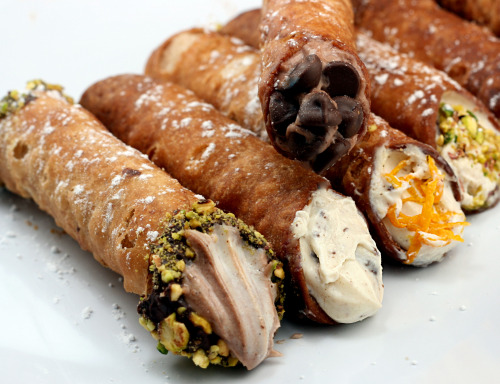
Finally, once you have hit Little Italy, which is just south of Soho, you have to go to Ferrara Cafe and have a pastry and coffee. I recommend a cannoli! Yum Yum Yum Yum Yum......etc.

195 Grand Street
b/w Mulberry & Mott St.
New York City, NY 10013


Has anyone visited the New Museum, SoHo or Little Italy yet? If so, what did you think?
If not, go and let us know how you enjoyed it!

Friday, March 25

Why NYC's public transportation is amazing

Rainy days are not fun. Especially when the rain turns into little balls of ice that pummel your face like it's a moving target - kind of like Wednesday. But when it rains, I am grateful for public transportation because I can stand in the shelter of the bus stop. That usually means that I can spare myself the sight of my pathetic umbrella flipping in the presence of the fiercely nonexistent wind.

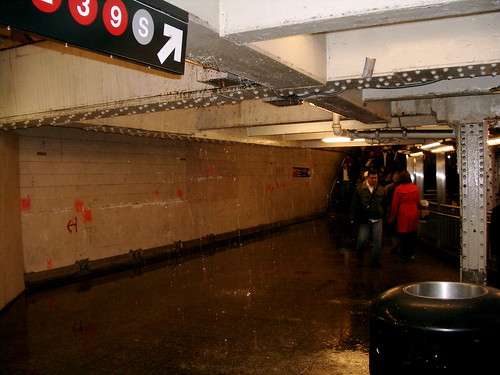
The waterfalls in the stations remind
 me of Niagara Falls.
But aside from these minor grievances, NYC does have a pretty amazing transportation system. Considering that you only need to pay $2.25 for a ride which can take you from one corner of the city to another, NYC's public transportation system is quite the system: the subway system alone has over 400 stations which service over five million people on an average workday.

Due to the fact that the subway system is so old - the first sections of the subway began operating in 1904 - there are some really impressive things about the subways, which, if you are feeling adventurous and decide to go exploring, can turn into an exciting expedition. Like the adventure that I had on the 6 train.

So I was on the 6 train one weekend and, it being the weekend, the train skipped my stop and went straight to it's last stop. Since I am lazy, I decided that I should just stay on the train. I mean, the trains always turn around, right?

The old City Hall stop. It looks just like this
in real life!
I wasn't actually sure. But I had made my choice and I wasn't going to admit I was wrong so I sat back in my seat and pretended to know what was going on. Then the most amazing thing happened: the 6 train went by the old City Hall station which was closed in 1945. It was gorgeous. The experience was like discovering a dinosaur fossil - or what I imagine it would be like to discover a dinosaur fossil.

Anyway, the point is that the subways are pretty cool: they're cheap to ride on and full of history. So if you had the chance to check out the New York Transit Museum, you should go. You'll definitely find out more about the quirks of the transportation system. Coincidentally, One To World is organizing a tour of the New York Transit Museum on Tuesday, April 5th. And what a coincidence! Here's a link to where you can register for the One To World tour.

Maybe you should click on it. What with all the coincidences, today may just be your lucky day!

Friday, January 21

NY Knicks Basketball - You've Got To Be There!

At the end of this month, One To World is giving students a unique opportunity to attend a Knicks vs. Pistons game at Madison Square Garden – complete with private box seating and VIP access to the pre-game players warm up. After having not made the playoffs in 6 years, things are finally starting to look up for the New York Knicks who are in a good position to make the playoffs.

Considering that the Knicks suffered their worst home loss at Madison Square Garden against the Dallas Mavericks nearly a year ago to date, the upcoming matches seem to be much more promising and are sure to be exciting to watch. At the very least, the probability of another devastating 50-point loss seems to be essentially nonexistent given the Knicks’ performance this season!

Perhaps with this season’s arrival of the talented Amar’e Stoudemire, the New York Knickerbockers will be able to recapture some of their former glory days – a period between 1968-1875 where the Knicks made four 50+-win seasons, three Eastern Conference Championships, and two National Basketball Association (NBA) titles. However, regardless of whether the Knicks are able to repeat past accomplishments from their “golden era,” the simple fact that they’re doing so well this season has garnered them a generous amount of attention, not surprisingly so since Americans have a cultural fascination with the game of basketball.


But the reason behind basketball’s popularity in America might simply be because the game was first created in the USA. In December 1891, Dr. James Naismith, a Canadian physical education professor, created basketball to occupy the gym class that he was teaching at Springfield College, located in Springfield, Massachusetts. The game quickly spread through the US, and subsequently to Canada, thanks to its prevalence in YMCA’s throughout the US; it quickly gained a following in colleges and high schools throughout the nation.

In fact, one of the reasons why basketball spread so quickly to so many – even establishing itself on an international stage - is because of its minimal equipment and personnel requirements. In the 2008-2009 academic year, for example, over 900,000 students in over 17,000 high schools throughout the US played basketball competitively. The sport has also inspired a number of movies for children and adults alike: if you can remember back to your childhood days, you might recall Hoosiers, Space Jam and Air Bud movies; and more recently, Coach Carter and Glory Road.

 What role do sports play in your home community? How do U.S. sports fans compare with fans in your home country?

Monday, December 20

Christmas Traditions Around the World

Christmas in NYC, Rockefeller Center.

In the US, Rudolph the Red-Nosed Reindeer usually heralds in the Christmas season with his omnipotent presence in the media – from TV to radio to print. He even has several songs dedicated to him, songs that most schoolchildren know how to sing by heart. With this superstar status, Rudolph is probably one of the more prominent symbols of the festivities which dictate the holiday season. But Rudolph may not have as strong a cult following in other countries around the world. Here are a few ways in which different countries around the world celebrate Christmas:

In the US, for example, the typical American family would celebrate Christmas by putting up a Christmas tree, decorating their house with Christmas lights and wreaths, and exchanging gifts on Christmas Day. Families also come together for a Christmas dinner.

In Argentina, Christmas falls in the summer, when temperatures are warm and skies are blue. So when the typical Argentinean family puts up their Christmas decorations, they might put cotton balls on the branches of their Christmas tree to simulate snow. When Christmas Eve rolls around, families light fireworks and “globos,” paper decorations which take off into the sky once they are lighted.

Globos in Argentina.
Bondi Beach, Sydney.


In Australia, another country in the Southern Hemisphere, many Australians spend Christmas outdoors to take advantage of the warm weather. Christmas dinner might be in the form of a barbecue and friends and families might gather for a day at the beach or at the park. Some families might even spend the Christmas holiday at a camping ground.


In England, Christmas preparations and traditions are similar to those of the US’s – people decorate their homes, hang stockings up, have Christmas dinner, and open presents on Christmas Day. One difference, though, is that most families would gather to watch the Queen’s speech to the Nation and Commonwealth at 3 pm on Christmas Day. On the day after Christmas, December 26th, England observes Boxing Day, which is a day of shopping similar to Black Friday. 


In China, Christmas is celebrated mainly by Christians but the commercial aspect of the holiday has been spreading. So although there are Christmas decorations, the winter season is indicative of another holiday – Chinese New Year – for the majority of Chinese families. Those who do celebrate Christmas would most likely put up plastic Christmas trees decorated with paper chains, paper flowers, and paper lanterns and attend Midnight Mass.

A Chinese Christmas tree
In France, children put their shoes by the fireplace on Christmas Eve in the hopes that "Pere Noel,” or Santa Claus, will bring them toys. Unlike the US rendition of Santa Claus, Pere Noel is tall and thin. On Christmas Eve, there is a feast called "Le Reveillon." After this dinner, many families serve a "Buche de Noel," a sponge cake decorated like a Yule log.
Buche de Noel.
In Ghana, people celebrate Christmas from the 20th of December to the first week in January with lots of different activities. Many people travel to visit their relatives and friends in other parts of the country. But because there are so many ethnic groups in Ghana, there is no single Christmas tradition which the majority of the people who celebrate Christmas participate in.  

In India, it is mostly the Indian Christians who celebrate Christmas. Because of India’s climate, most of them decorate mango or banana trees instead of the traditional pine trees at Christmas time; they might also decorate their houses with mango leaves. Families also place “diyas,” small oil-burning lamps made of clay, on their rooftops, symbolizing their view that Jesus is the light of the world.


Banana tree with decorations.


How does your family or culture celebrate Christmas? If you don't celebrate Christmas, what are some traditions that you have for your holiday?

Friday, December 10

World Cup Update and Other Cultural Pastimes


Now that the semester is winding down, you may invariably find yourself with some extra time on your hands. So what do you do when you’ve finally recuperated from the sleepless nights spent cramming for finals? Some of you might want to relax with a glass of wine and some cheese. But for those of you who are inclined to be more active, cheese-rolling might be something to look into.

Yes. Cheese-rolling. The sport is pretty simple: all you have to do is find a wheel of cheese, roll it down the side of a hill – preferably, the steeper the better – and chase after it. If you think you’ve got what it takes to be a professional, you can head over to Gloucestershire, England to participate in their annual cheese-rolling competition which takes place in the spring. But if chasing cheese down a hill isn’t your cup of tea – maybe you're extremely lactose intolerant and can't come within 50 feet of cheese or maybe you're not too keen on ending up with a lot of bandages on your knees and some on your face –  chasing a ball on a flat field might be more appealing. 

Although that’s not to say that football (or soccer as the Americans call it) doesn’t have its fair share of injuries. But generally speaking, football is an overall more popular pastime than cheese-rolling. So if you happen to be an avid football fan, you might already be aware of the situation with the several upcoming World Cups: it has been determined that the 2014 tournament will be held in Brazil, 2018 in Russia, and 2022 in Qatar.

And the recent decision to let Qatar host the 2022 World Cup has caused quite the flurry of reactions. For one thing, Qatar will be the first Middle Eastern country to host the tournament so being in the international limelight will help foster cross-cultural understanding between the Middle East and the rest of the world.

Additionally, Qatar is promising to leave a substantial football legacy behind: some of the stadiums that the country is building for the World Cup will feature a design which can be dismantled after the tournament. Once the tournament is over, this special feature will allow Qatar to rebuild up to 22 stadiums in developing countries that looking to develop their football infrastructure. 

But while Qatar is looking to create an impact on the history of football, the country itself doesn’t have a particular outstanding football history. Ranking as 113th in FIFA’s official rankings, Qatar has never actually qualified for the World Cup. This may be a potential problem as the host team traditionally advances past the opening playoffs. In fact, FIFA takes pains to ensure that the host team has a good chance of moving past the opening round by giving the host team a top seed.

However, before it needs to even worry about moving past the opening round, Qatar must first overcome its infrastructure and weather challenges. Since the country currently lacks a complete public transportation system and only has 3 of the 12 stadiums that FIFA requires its host countries to have, Qatar will have to commit to some serious building and infrastructure development to accommodate the players and spectators.

The scorching weather –temperatures can reach up to 50 °C (122 °F) in the summertime – is also challenging Qatar to incorporate innovative design mechanisms into its stadiums’ cooling systems. Which is why the country is looking to utilize solar energy to power the nine new, fully air-conditioned, and carbon-neutral stadiums that the country will be building.

If all goes according to plan, Qatar will finally be able to deliver on it’s promise of “[showcasing] the best traditions of the world’s greatest sporting event, while presenting astonishing innovations aimed at further propelling football’s worldwide growth” when 2022 finally rolls around.

What do you think? What are your opinions on Qatar winning the bid to host the 2022 World Cup?

Monday, December 6

Education Debate in London


As you may – or may not – know, the cost of higher education in the United States can be exorbitant. Generally speaking, tuition varies greatly depending on the type of institution you are applying to and a number of other factors like whether you are an in-state or out-of-state student. On average though, public four-year colleges charge $7,605 and private colleges charge $27,293 per year for tuition. Add on housing fees and other miscellaneous costs and you could end up paying quite a bit of money (or borrowing quite a bit of money) to attain a higher education.

Britain, however, has a different approach. In fact, higher education was tuition-free until as recently as 1998, the year means-tested tuition fees were introduced. However, those fees were capped at £3,000 ($4,700) in 2003 since the general sentiments in Britain are that a low-cost education is an intrinsic right,. Recently, however, due to budget deficits, the British government has been considering raising tuition and removing some subsidies for university students, causing protests and riots to break out throughout Britain.

On November 10th, for instance, up to 50,000 students marched through the streets of London to protest the tuition hikes, proposed by the Conservative Party, which could triple tuition rates to £9,000 ($14,200). The protest turned violent when students shattered the windows of the Millbank Tower, the Conservative Party’s headquarters, spray-painted anarchy symbols on the walls, and occupied the building.

Just last week, on November 24th, another crowd gathered in London to demonstrate against the tuition increase. A few protesters managed to break into a police van, after smashing the windshield and spray-painting the side; protesters also threw missiles at buses in central London, smashing windows and causing many routes to be diverted away from the Whitehall and Trafalgar Square area. Demonstrations also occurred in: Brighton, Manchester, Leeds, Bristol, Birmingham, Oxford, Liverpool, and Sheffield. And in places like Winchester, Cambridge, Leeds, and London, number of students walked out of class to protest the tuition increases.

What is your opinion about the proposed tuition increases in Britain? How do you think you would react if you were in the same situation? What are your thoughts on tuition in the United States in comparison? Please leave us a comment with your thoughts!

This post was researched and written by One To World intern, Jessica Zhang.


Thursday, December 2

Thanksgiving Wrap-Up

If you happened to go shopping at Macy's on Black Friday, you would have probably noticed a few things that told you Thanksgiving is unequivocally over:

  • The animated Christmas display in their store windows. However, the perpetual crowd that stands in front of the display makes it understandable if you bypassed the whole thing altogether.
  • The lights adorning Macy’s main entrance. But you are in New York and New Yorkers do walk with a purpose – who has the time to be looking around?
  • The Christmas trees scattered every few feet inside the store. But as shopping is such an extreme sport, it is perfectly excusable if you were so engrossed in your shopping that you didn’t notice them.

Even if you were at Macy's and missed all of the above signs, there really is no excuse for not noticing that the Holiday season is upon us: there is holiday music galore on the radio; the Salvation Army is showcasing their latent bell-ringing talents around major landmarks in Manhattan; and the UNICEF snowflake is back up on its perch on 57th and 5th! You can’t help but notice these festivities everywhere you look.

            But before we get caught up in the hustle and bustle of the holiday season, let’s recap our Thanksgiving celebrations. This year, 125 students were able to experience an authentic Thanksgiving with American host families in and around New York - spanning 4 states. Some spent the day celebrating the holiday and some spent the entire 4 day weekend with their hosts. Besides meeting new people, learning about Thanksgiving traditions, and having amazing dinners, some of the students also had the opportunity to travel a bit with their host families. Take a look at what some of the student’s did over their Thanksgiving weekends!

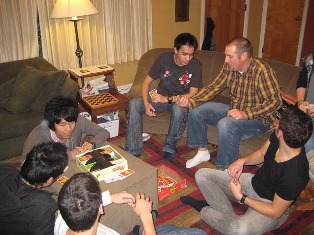
Learning to play Apples to Apples.

“Today was wonderful. The students are great - we want them back, anytime! This has been the very best, and important, Thanksgiving I've ever had.”  ~Host in Westchester County, NY

At the Choo Choo Barn in Strasburg, PA.

“I am so impressed by my host family, they are so generous! They are the best people who I have met in U.S.A. If I didn't attend this program, I am sure I would thanksgiving day without any meaning. It was great chance in my life time!”  ~Song Yang, Student from South Korea

Having Thanksgiving dinner!
“We had a wonderful weekend. Lots of fun and special memories. One Chinese student shared that this was her first time out of NYC in the year she has lived there.  She had been depressed and lonely-  ready to go back home to China. She said that she experienced love here during the weekend that she hadn't seen since arrival in the US.  She was encouraged and able to keep going. I sat in silence with tears in my eyes. That is the reason we do what we do!”  ~Host in Lancaster, PA
  

At Hershey Park in Hershey, PA.

“My dinner and thanksgiving was awesome. Surprisingly there were lots of topics to discuss and the food was great and the hosts were hospitable in every way. They made me feel quite at home and I had a great time.”  
~Naurin Ramay, Pakistan

At the Bird-in-Hand Farmers Market in Lancaster, PA.

“From this, I knew more American customs from the Thanksgiving holiday - not from books.  Their devotion deeply affected me.  Several get-together activities were full of fun.  This program is beneficial to people coexisting peacefully.” ~Jenny Hua Liu, Student from China

Browsing the shops in Amish Country.

If you have any stories of your Thanksgiving experience that you’d like to share, we’d love to hear about it!
  
This post was researched and written by One To World intern, Jessica Zhang.

Tuesday, November 23

The Beaujolais Has Arrived!

You probably know that the American phenomenon of Thanksgiving takes place on the fourth Thursday of November. But did you know that the third Thursday of November also has a claim to fame? It is the day that the most recent Beaujolais vintage becomes available to the world. 

So why does Beaujolais have a day all to itself? According to a rule established in 1985, Beaujolais, a wine produced from the Gamay grape, cannot be uncorked until it strikes midnight on the third Thursday of November. Hence the wine uncorked on this day bears the name ‘Beaujolais Nouveau’ – new Beaujolais. Millions of bottles of Beaujolais are opened on the third Thursday of November - nearly half of the 13 million cases of Beaujolais that are produced annually are sold within a few weeks of this day – and it has become a cause for celebration for people worldwide. 

If you try Beaujolais, you’ll notice that it has aromas of pear, apples, ripe cherries and other fruity smells. And this year’s harvest has produced a fruity, supple wine that wine lovers are already saying stands up quite well to the 2009 vintage, a vintage which has been praised as nothing but excellent. Since Beaujolais tends to be a lighter wine, it can be easier to drink than fuller-bodied reds and serves as a great ‘transition’ wine from whites to reds.

Coincidentally, Beaujolais also pairs well with poultry. So if you’re planning to make your own turkey feast this Thanksgiving, know of someone looking for a good wine pairing for their turkey dinner, or are just curious, Beaujolais might be a good option for you to try. 

If you’ve tried it, let us know what you think of Beaujolais. How important or unimportant is wine in your culture? Are there wines that accompany certain traditions, holidays, or ceremonies in your culture?


This post was researched and written by One To World intern, Jessica Zhang.

Wednesday, November 17

Cultural Cuisine


On Wednesday November 3rd, One To World once again hosted its one of the most popular events--Cultural Cuisine. This time, ten Fulbright grantees and international students came to sit around a table to discover Chinese Cuisine in the heart of New York City's famous Chinatown. Besides tasting the authentic Chinese Cuisine and discovering the uniqueness of Chinatown, students had a great time meeting new people and catching up with old friends.

The countries represented were:
South Korea   China   Austria   Germany   Ireland   Cyprus   Canada   Honduras

Thank you to everyone who attended! Don't forget to stay tuned for more great events brought to you by One To World.

Send us a comment and tell us about your Cultural Cuisine experience on Wednesday, November 3rd- Which dish was your favorite? What did you learn about Chinese cuisine? 

This blog post was written by One To World intern, Xi Chen, graduate student at NYU and leader of this Cultural Cuisine outing. 

Friday, October 15

Discover New York with One To World

Host, Monica Mecca and student, Yaeji Chun


Have you ever been in a foreign locale and thought – “I really wish I knew a native to show me the places that are off the beaten track- I’d love to get a perspective of the city through the eyes of someone actually living here!”
 
One To World aimed to fulfill this request on Saturday, October 2nd with their first Community Visit of the semester- Discover New York. Thirty-four International students were paired with twenty native New Yorkers (or people that commute to NYC for work and play) and taken on unique tours planned exclusively by the New York City hosts themselves.

Students went beyond just taking a bite out of the Big Apple; they also had the chance to discover the outer-boroughs as many hosts brought their visitors to various neighborhoods in Brooklyn and across the Hudson River to Hoboken, NJ.

Send us a comment and tell us about your Discover New York experience on Saturday, Oct 2nd- Where did you go and what did you learn?

Furthermore- What is the most unique experience you’ve had in a foreign country? Did you have a traditional family-style dinner in native’s home? Did you watch a local sporting event or partake in some sort of recreational activity? We want to hear from you!

Mirko (Italy), Yashil (India), and Yolande (France)